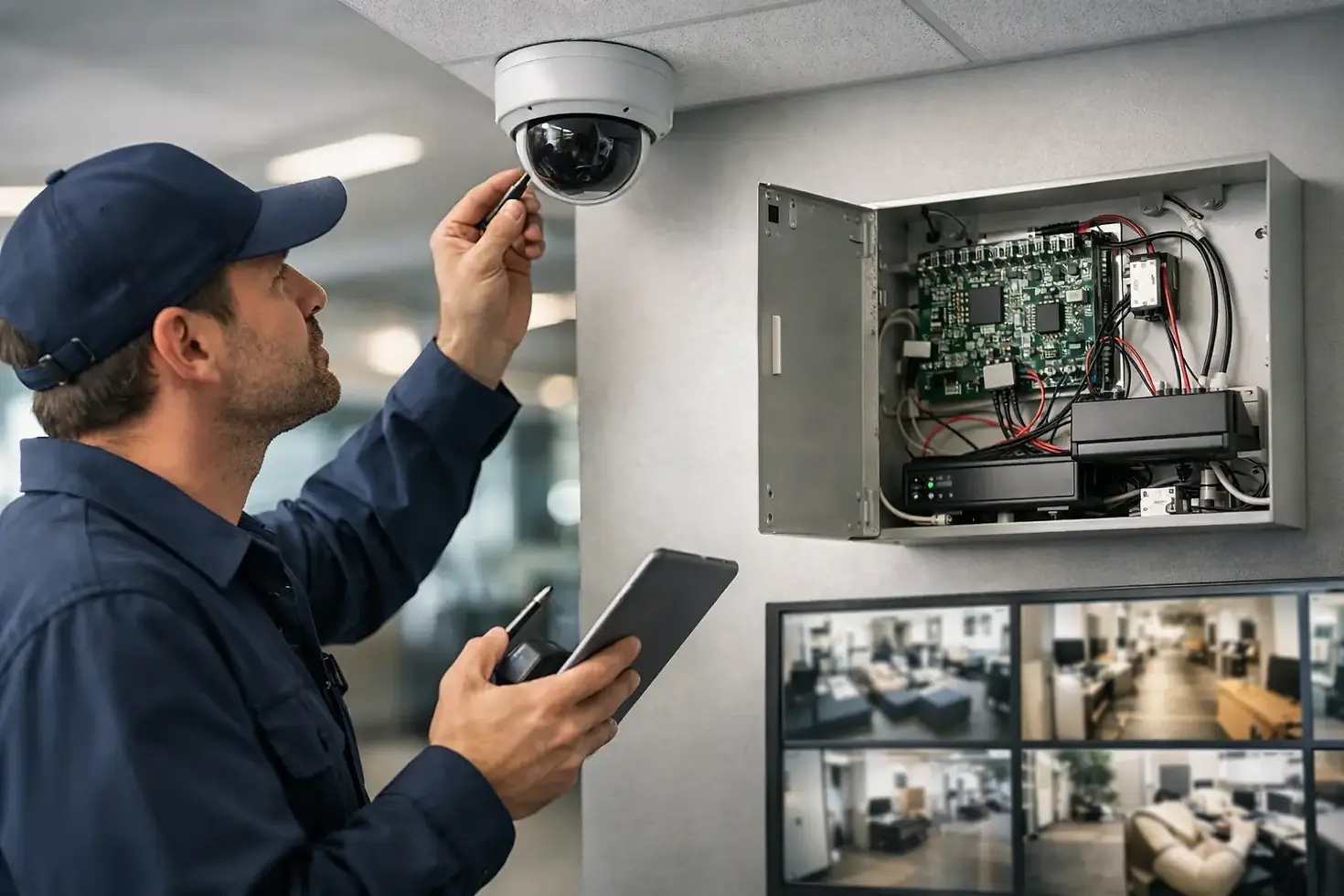
Commercial Security System Maintenance

A camera that records blurry footage, a door reader that works only on the second try, or an alarm panel showing old trouble signals - those issues rarely start as emergencies. They usually begin as small maintenance problems that were easy to miss until the system was needed. That is why commercial security system maintenance is not just a service line item. It is part of keeping your building protected, your staff confident, and your operation running without surprises.
For most businesses, security systems are expected to work in the background. If the front door unlocks on schedule, the cameras stay online, and the alarm arms at closing, nobody thinks much about it. The problem is that commercial systems do not stay reliable on their own. Devices age, firmware falls behind, wiring gets stressed, settings change, and day-to-day use exposes weak points that are not obvious until something fails.
What commercial security system maintenance actually covers
Maintenance is more than a quick visual check. A proper service routine looks at the full chain of performance - field devices, power, network connectivity, software, storage, user permissions, and physical condition.
For CCTV, that means checking camera positioning, image quality, focus, recording status, storage retention, time synchronization, and remote viewing access. A camera can be powered on and still be underperforming. Glare, dirty lenses, poor nighttime visibility, and misaligned views can make footage far less useful than owners expect.
For access control, maintenance includes testing readers, credentials, door contacts, request-to-exit devices, electric locks, schedules, and event logs. A door can appear operational while intermittently failing to latch, staying unlocked too long, or generating false alarms. Those are not minor annoyances. They affect security, employee flow, and liability.
For burglar alarms, service should include panel health, battery condition, sensor testing, communication paths, keypad function, and signal reporting. Backup batteries are a common weak spot. They may hold enough charge to avoid an obvious panel fault, but not enough to support the system during a real outage.
Why preventive service matters more than reactive repair
Waiting for failure sounds efficient until a problem hits at the wrong time. If a retail location loses camera coverage after a theft, or an office cannot reliably secure a perimeter door after hours, the cost is not limited to the repair ticket. You also have exposure, operational disruption, and time spent coordinating an urgent fix.
Preventive maintenance lowers that risk. It gives technicians a chance to catch declining components before they fail completely, identify configuration issues after staff changes or renovations, and verify that the system still matches how the building is being used.
This matters even more in multi-location environments. A business with five, ten, or twenty sites can easily end up with inconsistent device health, outdated settings, and different support histories from location to location. Regular service creates standardization. It becomes easier to know what is installed, what condition it is in, and where capital upgrades should be planned instead of rushed.
The hidden causes of security system problems
Most system issues are not dramatic. They build slowly.
Dust and weather affect cameras, especially around entries, loading areas, and exterior walls. Door hardware shifts over time, which changes alignment and creates intermittent access control problems. Network changes can interrupt communication between devices and servers. Power events weaken batteries and expose poor surge protection. Staff turnover leads to outdated access permissions, shared credentials, or users with more access than they need.
There is also the integration factor. Many businesses no longer run security as a standalone environment. Cameras depend on network performance. Access control may tie into remote management platforms. Alarm communication may rely on internet or cellular paths. When infrastructure and security overlap, troubleshooting requires a provider that understands both sides. That is often where maintenance gets more valuable, because the issue is not always at the camera or the reader itself.
How often commercial security system maintenance should happen
There is no single schedule that fits every property. It depends on traffic, building type, environmental conditions, compliance requirements, and system complexity.
An office with limited public access may do well with scheduled inspections once or twice a year if the system is stable and monitored between visits. A retail business, warehouse, healthcare office, or multi-tenant property may need more frequent attention because doors cycle constantly, camera coverage is business-critical, and user activity changes often.
Sites with exterior devices, gate systems, or high employee turnover usually benefit from shorter maintenance intervals. So do businesses that have had repeated nuisance alarms, recording gaps, or access control complaints. If a system is already showing warning signs, stretching the schedule usually costs more later.
What a good maintenance visit looks like
A useful maintenance appointment should produce more than a technician note saying everything was checked. Business owners and facility teams need clear visibility into what was tested, what passed, what needs attention, and what should be budgeted next.
That means documenting device condition, identifying failing batteries or storage issues, confirming software and firmware status where appropriate, and flagging any gaps in coverage or functionality. It should also include practical recommendations. Sometimes the right answer is a repair. Sometimes it is a configuration update, a cleanup of user permissions, or a targeted upgrade to a few high-risk components instead of a full replacement.
This is where hands-on service matters. Clean work, disciplined testing, and direct communication make a difference, especially when the visit happens during business hours. Maintenance should support operations, not interrupt them.
Commercial security system maintenance and compliance
Some businesses need maintenance for more than reliability. They need it for documentation, policy alignment, or insurance expectations.
If your organization has internal security procedures, visitor controls, access logs, or retention requirements for video footage, maintenance helps confirm the system is actually supporting those rules. A policy is only useful if the technology behind it is working as expected.
Insurance and liability concerns also come into play. If an incident occurs and footage is missing, doors were not securing properly, or alarm signals were not transmitting, the question becomes whether the system was properly maintained. That does not mean every business needs a complex compliance program. It does mean maintenance records and service history can matter when problems need to be explained later.
When maintenance turns into an upgrade conversation
Not every recurring issue should be repaired forever. At some point, maintenance reveals that the system design itself is falling behind your needs.
If parts are becoming difficult to source, camera quality no longer supports identification, access control software is too limited, or service calls keep tracing back to legacy wiring and hardware, replacement may be the more practical path. The key is making that call based on performance and cost trends, not frustration after another failure.
A good service partner will be honest about that threshold. Sometimes a system has years of useful life left with routine upkeep. Other times, continuing to patch it only extends downtime and uncertainty. The right answer depends on age, condition, and how critical the system is to daily operations.
Choosing the right service partner
Commercial security system maintenance works best when the provider understands the broader environment, not just individual devices. Security touches cabling, network performance, power, endpoint setup, and building workflow. If those pieces are treated separately, problems take longer to diagnose and longer to fix.
That is why many businesses prefer one technical partner that can manage security and related infrastructure together. Tekmatik supports organizations that need that kind of practical coverage - from cameras and access control to the wiring and connectivity that keep those systems stable.
Responsiveness matters too. A maintenance plan has real value only if the service team follows through with clear reporting, timely scheduling, and clean execution on-site. Business owners and operations teams do not need more vendor management. They need fewer loose ends.
A smarter way to think about maintenance
The best time to evaluate your security system is before it gives you a reason to. If your cameras, alarms, and access control are central to how you protect people, property, and operations, maintenance should be treated like uptime protection, not an afterthought.
A well-maintained system does not call attention to itself. Doors secure properly. Video is usable. Alarm signals are dependable. Staff can move through the building without workarounds. That kind of consistency is easy to overlook, but it is exactly what most businesses are paying for. Keep the system healthy, and it will stay ready when the moment actually matters.


Comments